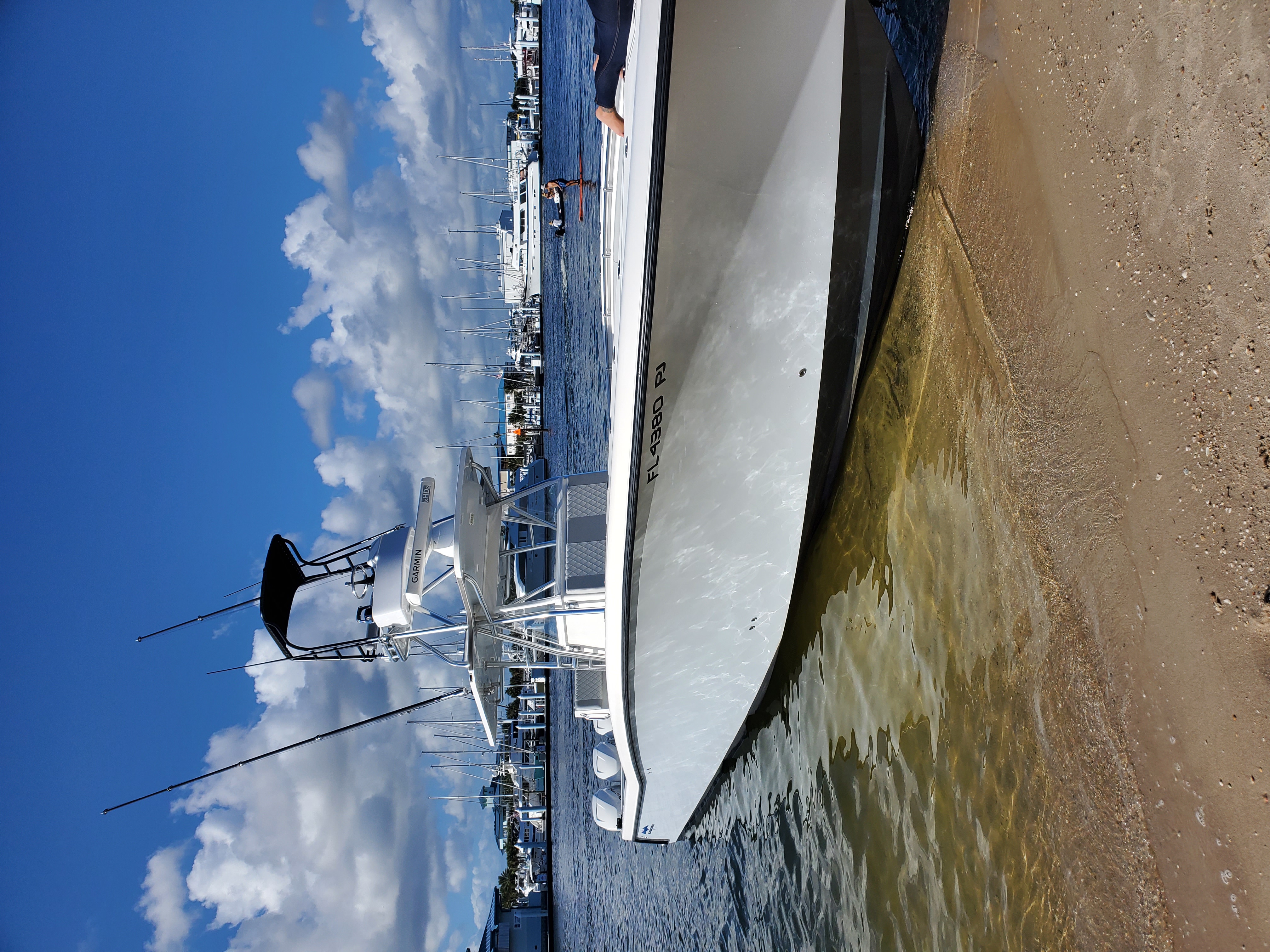
What to Look for in the Perfect Center Console
A broker's guide to hull design, engine configuration, build quality, and everything else that separates a great center console from an expensive mistake.
By Breck Yacht Group | Palm Beach, FL*
Buying a center console is one of the most personal decisions a boater can make. Unlike a cabin cruiser or a sportfish with an enclosed bridge, a center console puts you fully exposed to the elements — the spray, the sun, the wind — and that's exactly the point. The best ones are purpose-built machines that reward the buyer who knows what to look for. The wrong one is an expensive lesson.
After placing clients aboard dozens of vessels across every price point, here's what we tell every buyer who walks through our door.
1. Hull Design: Where Performance Begins
Everything starts with the hull. A deep-V hull with a deadrise of 22 degrees or more will give you a smoother, drier ride offshore in a chop — critical if you're running to the Gulf Stream or fishing 30 miles out in building seas. Shallower deadrise hulls (18 degrees and under) are more stable at rest and better suited for inshore and nearshore fishing, but they'll pound you in anything above a 2-foot chop.
Pay attention to strake design as well. Lifting strakes and spray rails aren't just cosmetic — they direct water away from the hull and generate lift at speed, improving both fuel efficiency and ride quality. Builders like Invincible and Hydra-Sports have spent decades refining their hull geometry. Freeman Boatworks takes a different approach entirely — their catamaran tunnel hull delivers an exceptionally dry, stable ride at speed and has earned a devoted following among serious offshore fishermen who prioritize rough-water performance above all else. That engineering investment, whether deep-V or cat hull, is a significant part of what you're paying for at the premium end of the market.
2. Engine Configuration: Match the Power to the Mission
No single decision impacts performance, operating cost, and resale value more than the engine package. Here's how to think about it:
Single engine suits center consoles under 24 feet used primarily inshore. Simple, economical, easy to maintain. The market for single-engine boats above 26 feet is thin, which affects resale.
Twin engine is the standard for 28- to 36-foot center consoles. Twin 300s or 350s give you redundancy offshore, manageable fuel burn, and the strongest resale market. If one engine goes down 40 miles out, you get home.
Triple and quad configurations are the domain of serious offshore platforms — 35 feet and up. Triple 400-horsepower outboards push a 35-foot boat to 65+ mph and are increasingly the configuration of choice for serious sport fishermen and performance buyers. The premium is real at purchase, but so is the performance and the demand at resale.
Engine brand matters too. Yamaha dominates the market on reliability and dealer network. Mercury's Verado line commands a premium for its supercharged performance and smooth power delivery. Match the engine to how and where you plan to run the boat — not just what looks impressive at the dock.
3. Build Quality: What You Can't See Matters Most
The difference between a $150,000 center console and a $450,000 one isn't always visible from 20 feet away. It's in the lamination schedule, the quality of the fiberglass layup, the hardware, and the systems integration.
Walk the boat carefully. Open every hatch. Look at the bilge — is it clean, well-finished, and logically organized? Are wire runs neat and properly labeled? Is the rigging done by someone who was proud of their work, or thrown together to hit a delivery date? Premium builders like Invincible, Yellowfin, Sportsman, and Freeman build boats that show their craftsmanship in places most buyers never look. Freeman in particular is known for an almost obsessive attention to fit and finish — their composite construction and hand-laid hulls set a high bar for the segment. That attention to detail is what holds value over a 10-year ownership cycle.
4. Fishability: Designed for the Way You Fish
Even if you don't fish every trip, a well-designed center console is built around fishing functionality — and those features matter for the overall ownership experience.
Key things to evaluate:
Livewell capacity and placement. A serious offshore boat needs a livewell that can keep ballyhoo and goggle-eyes alive on a long run. Placement matters — you want it accessible from the cockpit without stepping around gear.
Rod storage. Gunnel rod holders are table stakes. Flush-mount rod tubes under the gunnel keep rods protected and out of the way. Under-gunnel storage for rigged rods is a premium feature on the best boats.
Cockpit layout. Can four people fish comfortably without tangling lines? Is there enough room to fight a fish around the boat? Can you access the engine(s) quickly if something goes wrong?
Transom design. A well-designed transom step makes boarding and fish handling significantly easier. Integrated bait prep stations with cutting boards, sink, and tackle storage are standard on quality builds above $300,000.
5. Electronics and Navigation: Don't Underinvest Here
The electronics package on a modern center console can easily run $50,000 to $100,000 on a high-end build — and it's worth it. Navigation, fish-finding, and communication technology have advanced dramatically in the last five years.
Look for a multi-function display (MFD) network from Garmin, Simrad, or Furuno that integrates your chartplotter, sonar, radar, and autopilot into a single system. For serious offshore fishing, CHIRP sonar and live sonar capabilities like Garmin LiveScope have become near-standard on premium boats.
VHF with DSC (Digital Selective Calling) is non-negotiable for safety. Satellite communication capability for runs beyond VHF range is worth serious consideration if you're running to the Bahamas or deep offshore.
6. Comfort and Amenities: The Long Run Reality Check
At 30 miles offshore, creature comforts stop being luxuries. A proper leaning post with bolster seating keeps your crew comfortable on long runs. A bow seating area with a sun pad gives passengers a place to relax at anchor. Adequate shade — whether a hard top or a T-top — is essential in South Florida.
Consider fresh water capacity, an enclosed or semi-enclosed head (even on a center console), and a 12V or shore power system adequate to run a quality sound system, charging stations, and navigation lighting. The best center consoles are day boats that can handle an overnight with the right preparation.
7. Resale Value: Think Like a Seller Before You Buy
The best time to think about selling a boat is before you buy it. Certain brands, configurations, and build years hold value dramatically better than others.
Boats with twin or triple Yamaha or Mercury outboard packages in the 300-400 HP range have the broadest buyer pool and strongest resale. Unusual configurations — single engine on a 32-footer, non-standard colors, heavy aftermarket modifications — narrow your buyer pool when it's time to sell.
Condition and service history matter enormously. A well-maintained boat with documented service records will sell faster and for more money than an equivalent boat with an uncertain history. Keep your records organized from day one.
The Bottom Line
The perfect center console doesn't exist — but the right one for you does. It's the boat that matches your fishing style, your typical sea conditions, your budget, and your performance expectations. The buyers we see make the best decisions are the ones who slow down, ask the right questions, and resist the temptation to buy on aesthetics alone.
If you're in the market for a premium center console in South Florida, we're here to help you find it. Browse our current inventory or reach out directly — our brokers know these boats and know this market.
Breck Yacht Group specializes in luxury center consoles and sportfish vessels. Based in Palm Beach, FL.